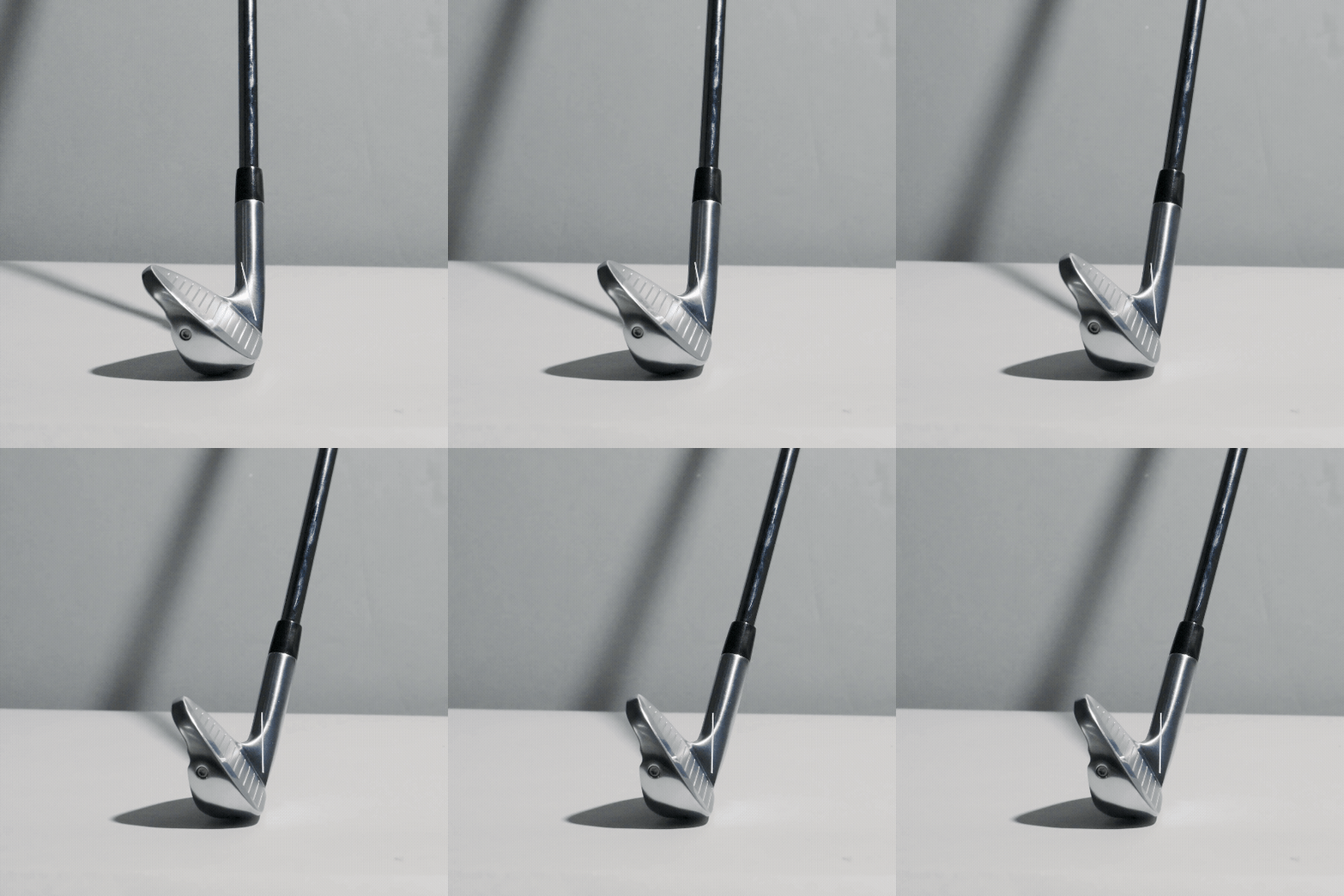
HOW THE IMPACT LINE WORKS

To achieve this position it’s important that you don’t push your arms and hands forwards independently of your body. That would be what’s termed as a “handle drag”. You rehearse reaching the optimal impact position by placing 90% of your weight on your lead leg. This requires you to shift your pelvis laterally towards the target while rotating your hips and leaning the handle forwards and de-lofting the club face, so that the impact line points to your eyes. This ensures your weight transfer and hip and torso rotation (your pivot) lead the movement of the handle through the impact area.  


It’s important to toggle between your set up position and impact position to develop a feeling of moving seamlessly from set up through impact.  
To begin the process of developing an optimal movement pattern, make some practice swings starting from the Impact Position by having your weight on your lead leg, with your hips rotated towards the target, and the handle forwards with the impact line pointing towards your eyes. Make a quarter length backswing leaving your weight on your lead leg and develop a feeling of how your hands, wrists and arms move the club from the optimal impact position into the delivery position (P6) where the shaft is parallel to the ground. Then move them back into the impact position.


It is critical to understand and develop a feeling for how your hands, wrists and arms move the club into impact. If you do this drill without a ball, but mark on the ground the position the ball would be in, you can start practicing making contact with the ground on the target side of the marker, so you develop a movement pattern that strikes the ball first then the ground.  


This is the essence of learning to become a more consistent ball striker. It all starts with educating your hands, wrists and arms, while getting your weight into your lead side. Once this movement becomes familiar, rehearse delivering the club into the same impact position with longer backswings.


So, rather than spending hours building a backswing and hoping for a good impact, focus your attention on the impact line and getting your weight into your lead side, so you develop a movement pattern that reliably delivers optimal impact conditions. 

It’s very simple, the impact line is an alignment marker on the hosel of the club head. It empowers you to locate the forward handle position and de-lofted square club face required to "sustain the line of compression", which is what Homer Kelley, the author of the seminal book "The Golfing Machine", stated was “The Secret of Golf".  


Reaching the forward handle position and club face orientation that the impact line promotes, ensures you maintain control over the handle until after the ball has been struck. You achieve this by leaning the handle forwards until the impact line is aligned with the leading groove on the club face and both the leading groove and the impact line point to your eyes. 

The DST Impact Line Hammer and Nail


Clarify your intention

You’ll make massive strides with your ball striking when you train your hands, wrists and arms to perform the underlying movement needed to compress the ball. This is simple to understand when there is no loft on the club because you have no expectations to see the ball flying in the air. When the task changes, your intention changes.  So when you’re told to hit a nail into the ground with a hammer, suddenly, the way you deliver the hammer into impact changes instantly. We’ve gone ahead and made these tools for you. They’re called the DST Impact Line Hammer and Nail and nothing clarifies the task of compressing the ball better than these. Because the Impact Line helps you locate the handle position needed to drive the nail into the ground. 


The ball position is key

Simply, set up with the ball one club head length inside your lead heel. For many golfers this will feel a long way forwards, but this distance between your lead heel and ball position is constant and remains the same for all shots when the ball is played from the ground. The only element that changes is, as the clubs get longer, your trail foot moves backwards creating a wider stance. This in turn moves your head further behind the ball. So, with shorter irons your head will be more on top of the ball and with longer clubs your head is behind the ball. This affects your eyeline to the ball. So, with shorter irons you will have more shaft lean than with longer irons. But importantly the angle between your lead arm and the club are the same at impact. The significance of this ball position is that the natural low point of the club head arc is under the lead shoulder. So when you have the ball positioned just before this location, it means you have to shift your weight laterally towards the target and get the handle forwards in order to strike the head of the nail in the downward direction that the nail is pointing. 


Club head path and face direction 

Ensure the tip of the nail is resting on the ground and is pointing in the direction of the target or minutely open to it. This provides your brain with a required hammer head path and face angle needed to deliver the hammer head against the head of the nail. When you develop a movement pattern that achieves this, you will have a low point location in-front of the ball.  This means you will have a ball then turf strike. 


As a drill, start from impact and work backwards 

The Impact Line points to your eyes only when the handle is in the optimal impact position. So, it enables you to familiarise and rehearse delivering the handle into the optimal position through impact. Knowing where you need to be at impact allows you to work backwards from impact to locate the delivery (release position P6) where the shaft is parallel to the ground. As a drill start from the impact position with 90% of your weight on your lead foot, with your pelvis and torso open to the target. While maintaining this position and only using your hands, wrists and forearms, move the club back until the shaft is horizontal to the ground and then seamlessly move it back to impact. This empowers you to develop a feeling of how your hands, wrists and arms work from the delivery position into impact. A movement where the lag angle between your lead forearm and club shaft unfolds. This is a movement that 96% of golfers get wrong during this critical part of the swing. The Impact Line Hammer educates your hands to un-cock the lag angle later in the downswing, which moves the location of the low point of the swing arc forwards of the ball. 


Don’t cheat by moving the ball position backwards

The tendency of the average golfer will be to cheat the process by moving the ball position to the middle of the stance or even further back, making it easier to achieve downward strike. However, when a golfer does this they move the point at which the club contacts the ground to be earlier. But the low point of the swing arc remains under the lead shoulder. When a golfer does this, they simply lower the entire swing arc depth which creates a very steep angle of attack which results in a deeper divot. When the ball is positioned correctly, opposite the lead heel, the golfer will recognise and understand that they need to move their bodies differently in order for ground contact to be made after the ball.  Golfers tend to find striking the ground on the target side of the ball, when the ball is positioned correctly, a difficult yet very insightful task. Once they can achieve this it’s a question of how consistently they can execute this movement. The more consistently a player has their low point in-front of the ball, the better ball striker they will be.


The smaller hammer face means precision and consistency are needed

Due to the Impact Line Hammer having a smaller striking face than an iron, it focusses the mind to be more precise in delivering the hammer against the ball. In fact, the face of the Impact Line Hammer is the same size as the sweet spot on an iron club. So developing a movement pattern where you can consistently strike normal golf balls into the ground with the Impact Line Hammer transitions very well into having a more repeatable and precise movement in your swing. 


The mirror

The mirror is part of the tool kit for you to see how you deliver the hammer against the nail from a ground level perspective. Simply rest the mirror against a wall at an angle so that you see the reflection of the ball. You’ll be amazed at how insightful this visual is. Its helps you align the barrel of the hammer with the shaft of the Nail and have a greater appreciation that the head is moving down through the ball not horizontal to the ground.